
Post-Construction Cleaning Checklist
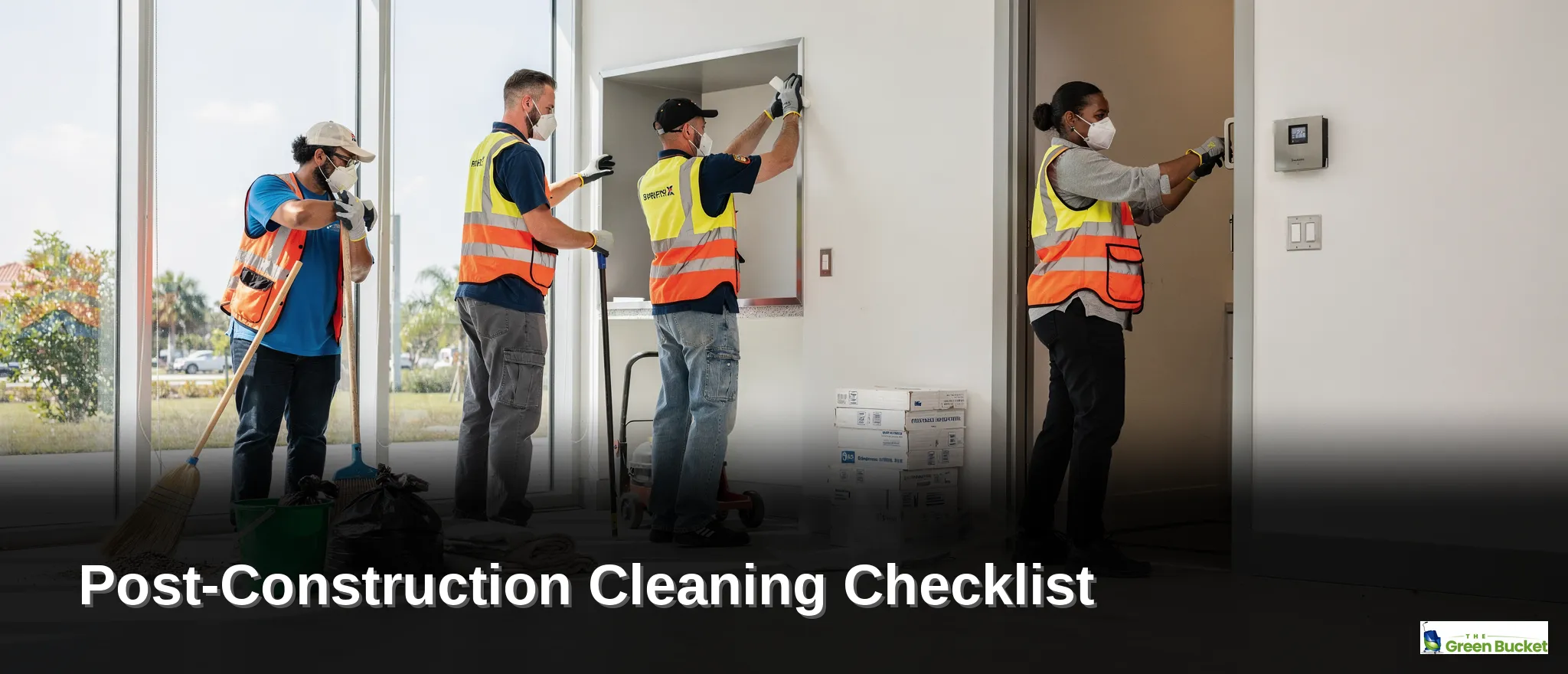
A complete post-construction cleanup checklist covers debris removal, dust elimination from all surfaces, and detailed sanitation of every fixture. The Green Bucket has provided commercial cleaning services since 2015 across Central Florida, ensuring spaces transition from construction chaos to pristine occupancy readiness.
Key Takeaways
A site assessment identifies high-risk areas and specific cleaning requirements before work begins.
Rough cleaning removes debris, dusts top-down, and uses HEPA vacuums to capture fine particles.
Detailed cleaning covers fixtures, windows, stickers, and adhesive residue left by contractors.
Final touches include floor polishing and surface disinfection to meet occupancy-ready standards.
What Does a Post-Construction Cleaning Checklist Cover?
A post-construction cleaning checklist covers the full transition from construction debris to occupancy-ready space. The checklist addresses safety, functionality, and aesthetics in a defined sequence. Facility managers rely on this structured approach to move a site from construction chaos to pristine order.
The process is vital not just for appearance but for safety and functionality. Thorough cleaning prepares the space for occupants and protects their health. Our team at The Green Bucket has provided commercial cleaning services since 2015 across Central Florida, giving us direct experience with complex post-build conditions.
What Are the First Steps in a Post-Construction Cleaning Checklist?
A detailed site assessment comes before any cleaning work begins. This evaluation identifies areas that require specific attention, such as adhesive residue, drywall dust, or paint overspray. The assessment shapes the cleaning plan and prevents missed hazards.
Conduct a site assessment to identify high-risk areas and specific cleaning requirements.
Remove large debris and construction materials left behind by contractors.
Perform rough cleaning of floors, walls, and surfaces to eliminate dust and residue.
Complete detailed cleaning of fixtures, windows, and hard-to-reach areas.
Apply final touches including floor polishing and surface disinfection.
What Does the Final Clean Checklist for Contractors Include?
A final clean checklist for contractors covers the detailed work that follows rough cleaning. This phase includes wiping down all surfaces, cleaning interior windows, removing stickers and labels, and addressing any remaining adhesive. Contractors use this checklist to verify that every trade has left the space clean and functional.
Our post-construction cleaning checklist incorporates these commercial construction cleaning tasks into a documented process. We provide post-construction cleanup as part of our comprehensive commercial cleaning solutions. The checklist ensures nothing is overlooked before handover.
How Does the Checklist Prepare a Building for Occupancy?
The checklist guides how to prepare building for occupancy after construction by sequencing tasks from rough to fine cleaning. Each completed phase reduces the risk of dust recirculation and surface contamination. The result is a space that meets safety standards and supports immediate use.
For post build cleanup Orlando projects, our team follows the same disciplined sequence. We document each phase and verify completion against the agreed scope. This approach protects the investment and delivers a space ready for occupants.
What Are the Prerequisites for a Commercial Cleanup?
A commercial post-construction cleanup requires three non-negotiable elements before work begins. The site must be assessed, the crew must be verified, and the end-state must be defined. Without these prerequisites, the transition from construction zone to occupied space stalls.
Why does a site assessment come first?
Every program begins with an assessment to align scope, frequency, and products to facility needs. We walk the entire footprint with the general contractor or facility director. This walkthrough identifies surface types, dust load, and any specialty areas requiring different cleaning protocols. The assessment produces a documented scope that eliminates ambiguity before the first crew member arrives.
What personnel standards protect the site?
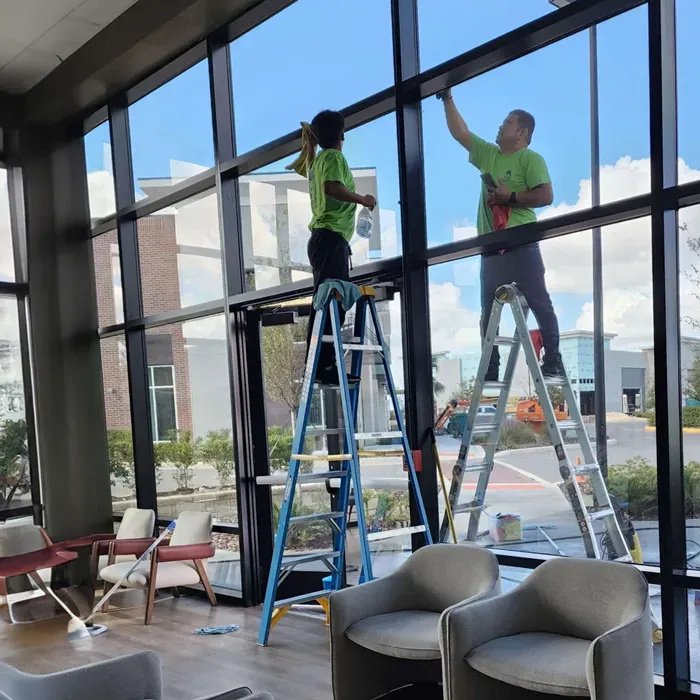
Our staff are trained, uniformed, and background-checked. Services are delivered by licensed, insured, background-checked, and uniformed staff. This standard matters because post-construction sites contain unsecured openings, exposed systems, and valuable installed finishes. Verified personnel ensure accountability on site from day one through final handover.
What defines a successful outcome?
The goal of post-construction cleaning is to create a clean and safe environment that is ready for occupants. We define this concretely during the assessment phase. Specific acceptance criteria cover surface dust levels, window clarity, floor finish condition, and HVAC register cleanliness. These criteria become the benchmark against which the final clean checklist for contractors is measured. A defined outcome prevents scope disputes and ensures the space meets occupancy standards without delay.
How Do You Execute the Rough Clean Phase?
The rough clean phase removes all construction debris and bulk materials. This initial stage clears the site for detailed finishing work. Post-construction cleaning goes beyond regular cleaning tasks. It involves a thorough cleanup of all construction debris, dust, and leftover materials. Without this critical first pass, subsequent cleaning phases cannot achieve the required standards for occupancy.
What Equipment Do We Use During Rough Cleaning?
Our team arrives with industrial-grade equipment selected for heavy debris removal. We prioritize sustainability by using non-toxic, biodegradable cleaning products. HEPA-filter vacuums capture fine particulate matter and improve air quality immediately. Microfiber cloths provide high-efficiency surface cleaning without leaving residue behind.
How Do We Sequence the Rough Clean Tasks?
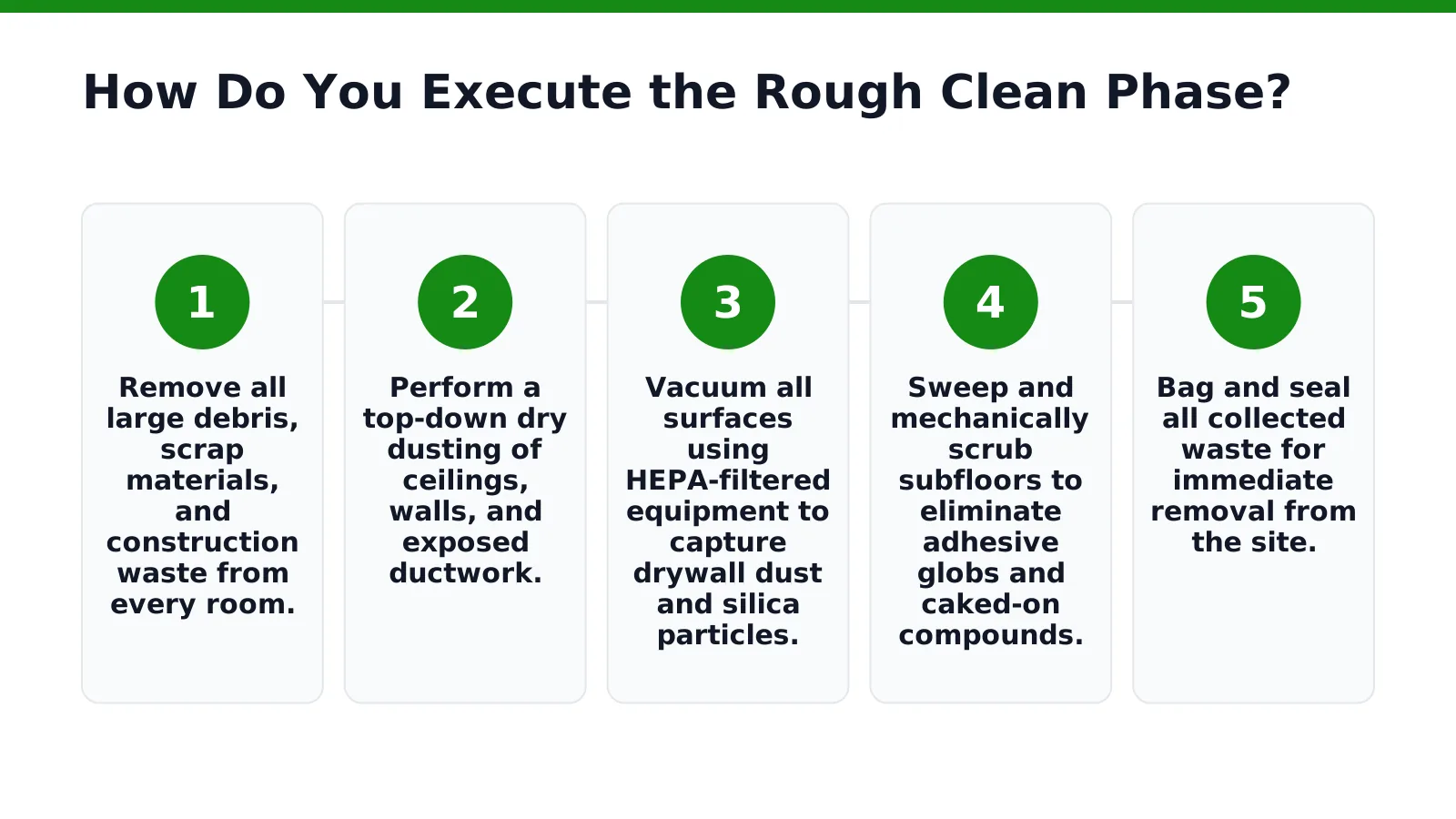
Execute these steps in strict order to prevent recontamination:
Remove all large debris, scrap materials, and construction waste from every room.
Perform a top-down dry dusting of ceilings, walls, and exposed ductwork.
Vacuum all surfaces using HEPA-filtered equipment to capture drywall dust and silica particles.
Sweep and mechanically scrub subfloors to eliminate adhesive globs and caked-on compounds.
Bag and seal all collected waste for immediate removal from the site.
Our team follows detailed checklists to document work and track outcomes against agreed scopes. Photo verification confirms each task meets our quality threshold before we proceed. The Green Bucket offers 24/7 service flexibility, allowing rough cleaning to occur on contractor schedules without delaying project timelines. This phase transforms a construction zone into a prepared canvas for the final clean.
What Steps Belong in the Light and Detail Clean?
The light and detail clean transforms a construction site into an occupant-ready commercial space. This phase addresses the fine particulates, smudges, and overlooked debris that rough cleaning leaves behind. Skipping these steps means handing over a facility where dust settles into electronics and adhesive residue mars new finishes.
Our process follows a structured sequence refined through years of commercial cleaning work across Central Florida. We begin with ceiling-level work and move downward, ensuring no surface requires re-cleaning.
What does a light clean cover after construction?
A light clean removes the visible dust film and debris that blanket every horizontal surface after drywall sanding and flooring installation. Our team wipes all ledges, window sills, and countertops using microfiber cloths that trap particles rather than redistribute them. We vacuum vents, light fixtures, and exposed ductwork before activating HVAC systems. Baseboards, door frames, and millwork receive a damp wipe to eliminate the fine white dust that clings to painted surfaces.
Dust all vertical and overhead surfaces. Start with ceiling fans, light fixtures, and crown molding. Work downward to walls, door frames, and baseboards. Use tack cloths or damp microfiber to capture gypsum dust.
Clean interior windows and frames. Remove construction stickers and adhesive residue. Wipe glass, tracks, and sills. Inspect for paint overspray on frames.
Vacuum and damp-mop all flooring. Use HEPA-filtered vacuums on carpets to extract embedded drywall dust. Damp-mop hard surfaces with a pH-neutral cleaner to avoid hazing new tile or stone.
Wipe all horizontal surfaces. Desks, counters, shelving, and window ledges require a wet wipe. Dry dusting simply relocates fine particulates into the air.
What tasks define the detail clean phase?
The detail clean addresses the imperfections that determine whether a space feels finished. Our trained and insured team inspects every outlet cover, switch plate, and plumbing fixture for smudges and fingerprints. We remove adhesive residue from glass, polish stainless steel, and clean inside cabinetry and closets. This phase also includes a full restroom sanitization using eco-friendly products and hospital-grade solutions where required for sensitive environments.
Detail all fixtures and hardware. Wipe switch plates, outlet covers, door handles, and cabinet pulls. Remove paint splatter with a plastic scraper.
Clean inside and outside of cabinetry. Vacuum drawer interiors and wipe shelving. Tenants will inspect these spaces immediately upon walkthrough.
Polish glass and mirrors. Use a streak-free cleaner on all mirrored surfaces, glass partitions, and entry doors. Inspect from multiple angles under bright light.
Sanitize restrooms completely. Scrub toilets, sinks, and urinals. Disinfect high-touch surfaces including flush handles, faucet controls, and stall latches. Our routine janitorial services include this as a standard deliverable for commercial buildings.
How do we verify completion before handover?
We conduct a final walkthrough with a detailed post-construction cleaning checklist that mirrors the punch list contractors use. Our team documents completed commercial construction cleaning tasks with photo verification, providing the monthly quality reports that facility managers rely on. This final clean checklist for contractors ensures no item escapes review before the space transitions to occupancy. For projects requiring post build cleanup Orlando teams trust, our local presence across Orange, Seminole, and Osceola counties enables rapid response and consistent site-level quality. The result is a building that meets the standard for how to prepare building for occupancy after construction: spotless, safe, and ready for tenants.
How Do You Perform the Final Touch-Up and Inspection?
Final touch-up and inspection transforms a construction site into an occupancy-ready facility. This phase catches overlooked debris, smudges, and functional defects before stakeholders conduct the formal walkthrough. Skipping structured verification leaves dust in HVAC registers and adhesive residue on millwork. Those defects delay handover and erode client confidence.
What Does a Final Walkthrough Inspection Cover?
A systematic walkthrough examines every surface under proper lighting. We inspect glass for streaks, floors for scuffs, and horizontal surfaces for residual construction dust. Door hardware, light switches, and outlet covers receive scrutiny for paint overspray or drywall compound. Baseboards and trim joints often hide fine particulate that general cleaning misses.
How Do We Document and Verify Completion?
Our team follows a disciplined verification protocol. As a veteran-owned company, The Green Bucket brings rigorous process management to every final inspection. We document completed work with photo verification and deliver monthly quality reports. Decision-makers track outcomes against the agreed scope without ambiguity. This documentation creates an audit trail that supports punch-list resolution and formal sign-off.
Execute the final touch-up in this sequence:
Inspect all glass surfaces and mirrors under both natural and artificial light, removing any remaining smudges or adhesive tags.
Wipe every horizontal surface, including door frames, window sills, and the tops of partition walls, where fine dust settles last.
Vacuum carpet edges and hard-floor corners with a HEPA-filtered unit to capture particulate that eddy currents deposit after air filtration stops.
Polish all plumbing fixtures and hardware to remove water spots and handling marks from the construction phase.
Verify HVAC vent faces are clean and correctly aligned, confirming no dust transfers to occupied airspace.
Our post build cleanup Orlando teams apply these steps across Orange, Seminole, and Osceola counties. The final clean checklist for contractors we use aligns with our move-in/move-out [deep cleaning services], ensuring the space meets health-first standards. The Green Bucket is fully licensed, insured, and bonded. We combine eco-friendly products with trained personnel and documented quality assurance. This integrated approach delivers a dependable program that prepares the building for immediate occupancy.
How Do You Prepare the Building for Occupancy?
Preparing a commercial building for occupancy requires a systematic final verification of cleanliness, safety, and functionality. The final clean checklist for contractors serves as the definitive protocol to transition a space from construction site to operational facility. Skipping this phase leaves dust in HVAC systems, residue on surfaces, and potential safety hazards unaddressed.
Our team executes post build cleanup Orlando projects with a structured approach that ensures every space meets rigorous standards before the first tenant walks through the door. The Green Bucket serves businesses in Orange, Seminole, and Osceola Counties in Central Florida, providing local support for occupancy preparation. Our Orlando location enables rapid deployment when project timelines shift unexpectedly.
What Are the Final Steps Before Occupancy Approval?
The final walkthrough confirms that all commercial construction cleaning tasks are complete and documented. We verify every surface, fixture, and system against the agreed scope. Flexible, 24/7 scheduling and emergency support are available to minimize disruption during the handover process. This adaptability proves critical when contractors face last-minute punch list items.
How Do You Verify the Space Is Truly Ready?
Verification demands more than a visual sweep. We follow a detailed post-construction cleaning checklist that covers three distinct phases: rough clean, final clean, and touch-up clean. Each phase addresses specific contaminants left behind after construction.
Remove all construction debris, protective films, and temporary floor coverings.
Vacuum and wipe every horizontal surface, including the tops of doors, light fixtures, and exposed ductwork.
Clean interior windows, frames, and sills to remove adhesive residue and drywall dust.
Detail all restrooms, break rooms, and high-touch areas with hospital-grade disinfectants.
Perform a final floor treatment appropriate to the material, whether stripping, waxing, or polishing.
Our team of 4 employees maintains direct communication and consistent site-level quality control throughout this process. A small, dedicated crew means no subcontractor confusion and no diluted accountability. We document completed work with photo verification, giving property managers confidence that the space meets health and safety standards before occupancy begins.
What Common Mistakes Should Contractors Avoid?
Post-construction turnover failures stem from preventable oversights. The most damaging mistakes involve communication gaps and undefined cleaning scopes. Contractors who skip structured handoff protocols face punch-list delays, occupant complaints, and costly re-mobilizations. Our team has managed commercial turnovers since 2015, and the same errors surface repeatedly when expectations remain vague.
Why Do Unclear Scopes Cause Turnover Delays?
Scope ambiguity creates friction at the final walkthrough. A final clean checklist for contractors must specify every surface, fixture, and system requiring attention. Without that specificity, cleaning crews miss critical areas. Contractors then absorb the cost of return visits. Our delivery model relies on customized plans built after on-site assessments and ongoing supervision to maintain standards. That structure eliminates guesswork.
How Does Poor Communication Undermine Occupancy Readiness?
Slow or inconsistent communication fractures the handoff timeline. When questions about commercial construction cleaning tasks go unanswered for days, move-in dates slip. Our mission prioritizes Response as a core principle. Rapid communication keeps schedules intact. Clear service agreements and defined communication paths ensure expectations are met and adjustments are simple. Contractors who treat cleaning as an afterthought rather than a coordinated phase lose control of the final milestone.
How to prepare building for occupancy after construction requires more than a mop and a vacuum. It demands a documented plan, verified completion, and a partner who answers calls immediately. We build every post build cleanup Orlando program around Quality, Response, and Simplicity. Those three pillars prevent the mistakes that delay occupancy and erode client confidence.
When Should You Schedule Professional Post-Build Cleanup?
The ideal time to book post build cleanup Orlando services arrives before construction concludes. Professional commercial construction cleaning tasks must align with the contractor’s closeout schedule and the occupancy date. Delaying the final clean checklist for contractors until the last available day creates unnecessary risk. Without a confirmed cleaning window, facility handover stalls and tenants experience a workspace filled with construction residue, not a business-ready environment.
Why Is Scheduling Before Final Walkthrough Critical?
Schedule professional cleanup after all trades complete their rough-in and finish work but before the owner’s final punch-list inspection. This sequence ensures our crews address drywall dust, adhesive residue, and protective film removal before stakeholders evaluate the space. The walkthrough reveals construction defects, not cleaning omissions.
Our post-construction cleaning checklist guides every phase of this process. We begin only when the general contractor confirms all subs have demobilized. Early scheduling locks in availability during the compressed window between substantial completion and certificate of occupancy.
What Flexibility Does a Commercial Cleanup Provider Offer?
We deliver 24/7 service flexibility for construction closeout timelines. Our crews mobilize during overnight hours, weekends, or directly after the last trade vacates. This adaptability prevents cleaning from becoming the critical-path bottleneck in your project schedule.
The phased nature of how to prepare building for occupancy after construction demands sequencing. We coordinate rough clean, final detail clean, and touch-up passes around your commissioning activities. Local knowledge and proximity across Orange, Seminole, and Osceola counties enable rapid response when schedules shift unexpectedly. Our service reaches business offices, medical practices, financial institutions, schools, and commercial buildings with the same documented quality standards.
How Does Phased Cleaning Support Occupancy Deadlines?
Post-construction cleanup follows three distinct phases that match construction milestones. The rough clean removes debris and bulk material immediately after major trades finish. The final detail clean addresses all surfaces, fixtures, and glass once punch-list work concludes. A pre-occupancy touch-up pass captures any settlement dust before doors open. Contractors who sequence these phases with a single provider avoid scope gaps and re-mobilization delays. Request a request a free quote to align your cleanup schedule with your occupancy deadline.
FAQ
What does a post-construction cleaning checklist cover?
A post-construction cleaning checklist covers the full transition from construction debris to occupancy-ready space, addressing safety, functionality, and aesthetics in a defined sequence.
What are the first steps in a post-construction cleaning checklist?
A detailed site assessment identifies high-risk areas and specific cleaning requirements before work begins. The next step removes large debris and construction materials left behind by contractors.
How does the checklist prepare a building for occupancy?
The checklist sequences tasks from rough to fine cleaning, reducing dust recirculation and surface contamination. The result meets safety standards and supports immediate use.
Conclusion
A documented post-construction cleaning checklist eliminates the ambiguity that delays occupancy and erodes client confidence. Contractors who sequence rough, detail, and touch-up phases with a single provider avoid scope gaps and re-mobilization costs. Scheduling professional cleanup before the final walkthrough locks in availability during the compressed window between substantial completion and certificate of occupancy.