
Daycare Cleaning Orlando: Best Practices
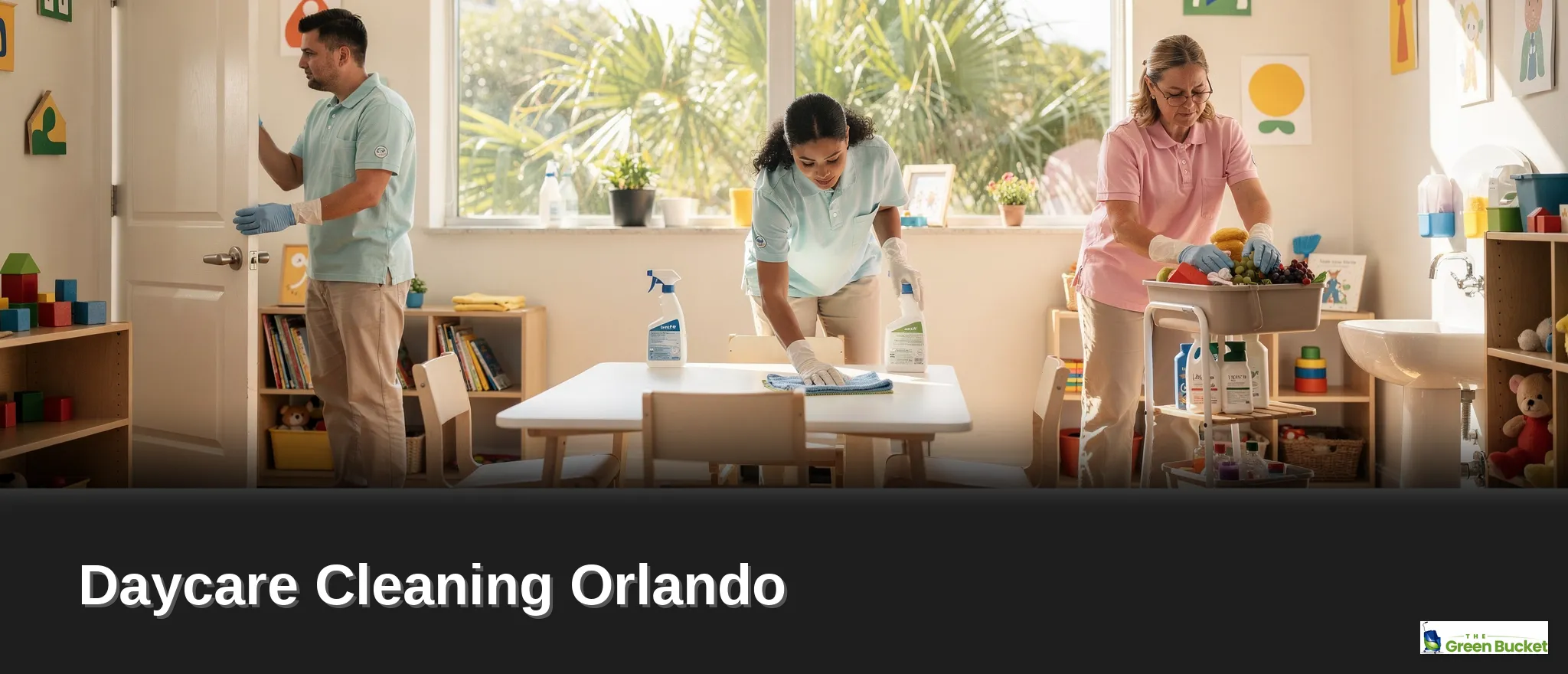
Daycare and educational facility cleaning requires child-safe, non-toxic products and rigorous disinfection protocols. Our family-owned business provides eco-friendly commercial cleaning services across Central Florida, including Altamonte Springs and Ocoee. We serve schools, preschools, and childcare centers with hospital-grade solutions that protect developing immune systems and meet parent expectations.
Key Takeaways
Child-safe, EPA-approved disinfectants replace harsh chemicals that pose risks in daycare environments.
HEPA-filter vacuums and microfiber cloths capture bacteria and improve indoor air quality.
High-touch surfaces, floors, and changing stations require priority disinfection to prevent illness outbreaks.
CDC and OSHA guidelines drive documented, room-by-room protocols for every area children access.
What is required for daycare cleaning compliance?
Daycare cleaning compliance requires adherence to CDC and OSHA cleaning guidelines for classrooms, restrooms, dining areas, play zones, and high-touch surfaces. Facilities must use child-safe, EPA-approved disinfectants while following documented protocols for every area children access. Without compliance, facilities risk failed inspections, illness outbreaks, and loss of parent trust.
What cleaning products are safe for daycare centers?
Many standard commercial cleaning products contain harsh chemicals, strong fragrances, and volatile organic compounds (VOCs). These substances pose risks in environments where children touch floors, mouth toys, and breathe close to surfaces. Our childcare facility sanitization approach replaces these products with non-toxic, biodegradable alternatives. We also deploy HEPA-filter vacuums to improve indoor air quality and microfiber cloths for high-efficiency cleaning.
How do you clean daycare centers to meet health standards?
Meeting health standards demands a systematic, room-by-room protocol. We follow these steps for every educational facility cleaning engagement:
Assess all zones: classrooms, restrooms, dining areas, play zones, and high-touch surfaces.
Select EPA-approved, child-safe disinfectants appropriate for each surface type.
Clean surfaces first to remove soil, then apply disinfectant with proper dwell time.
Vacuum carpets and floors using HEPA-filter equipment to capture fine particulates.
Document completed tasks with photo verification and monthly quality reports.
Our daycare cleaning Orlando programs serve Orange, Seminole, and Osceola Counties. We have provided commercial cleaning services for over 14 years. Every team member receives training on these protocols before entering any facility. The result is a documented, repeatable system that satisfies regulatory requirements and protects developing immune systems.
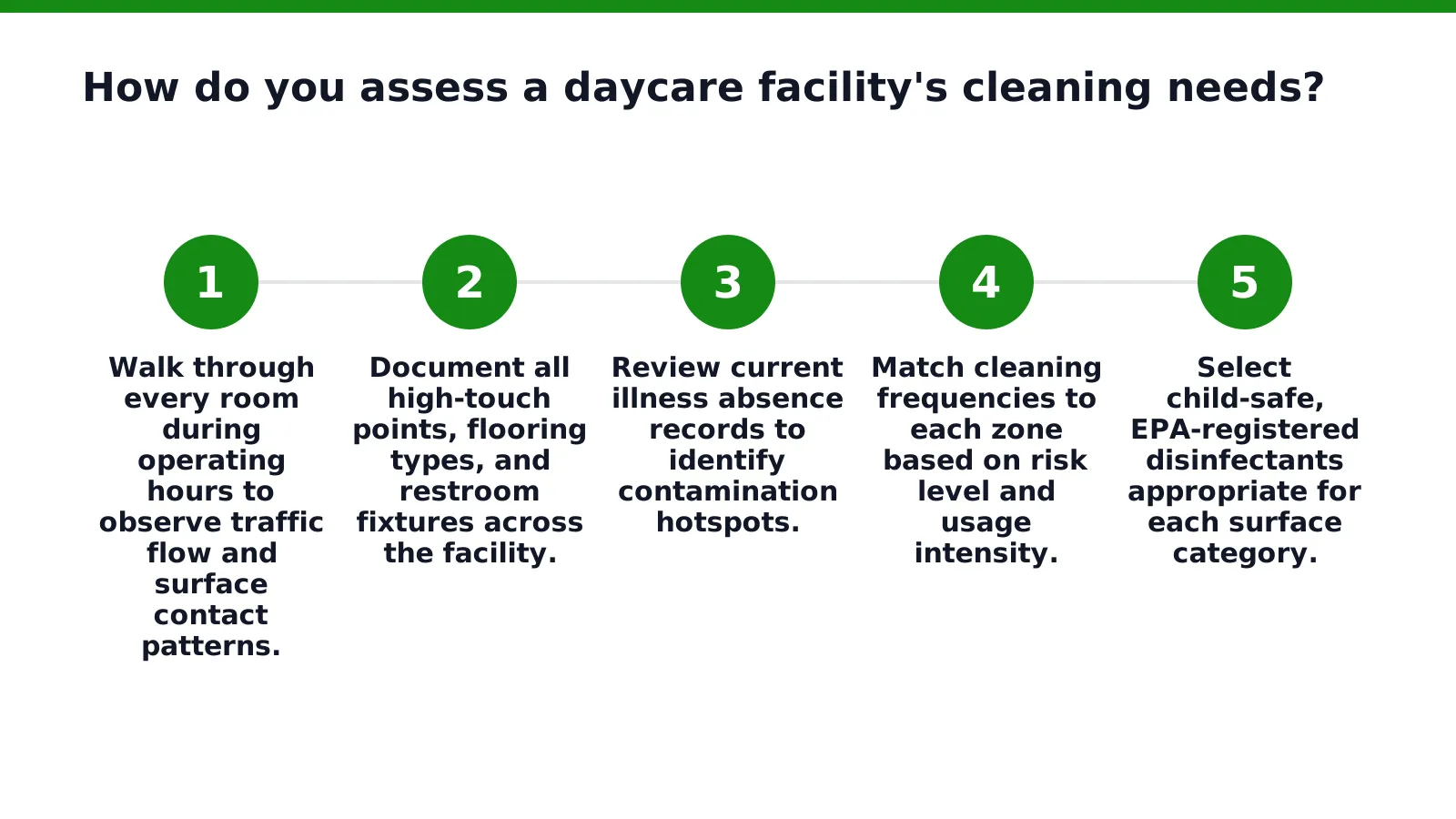
How do you assess a daycare facility’s cleaning needs?
A thorough assessment identifies every surface, schedule gap, and product requirement before cleaning begins. Our process maps the facility’s unique risk points to a customized plan that protects children and satisfies licensing standards.
Young children in daycares are constantly in contact with floors, toys, and shared surfaces. Their immune systems are still developing. Small gaps in cleaning lead directly to germ transmission and illness outbreaks that disrupt operations and erode parent trust.
What areas in a daycare require the most attention?
High-touch surfaces demand priority. Door handles, light switches, faucets, toilet flush levers, and shared toys accumulate pathogens rapidly. Floors in crawling areas and nap zones need specialized attention because children spend extended time at ground level. Changing stations require hospital-grade disinfection after every use.
How do we determine the right cleaning frequency?
Every program at The Green Bucket begins with an assessment to align scope, frequency, and products to facility needs. We evaluate daily enrollment numbers, room usage patterns, and peak traffic periods. Classrooms with infants and toddlers typically need multiple daily cleanings. Administrative offices and staff break rooms follow a different cadence.
The assessment follows a structured sequence:
Walk through every room during operating hours to observe traffic flow and surface contact patterns.
Document all high-touch points, flooring types, and restroom fixtures across the facility.
Review current illness absence records to identify contamination hotspots.
Match cleaning frequencies to each zone based on risk level and usage intensity.
Select child-safe, EPA-registered disinfectants appropriate for each surface category.
The Green Bucket serves a wide range of clients including schools and commercial buildings across Central Florida. We customize every plan around the facility’s schedule and cleaning needs. Our educational facility cleaning protocols integrate seamlessly with school calendars, after-hours access windows, and staff availability. The result is a documented scope of work that leaves no surface unaddressed and no schedule conflict unresolved.

Which cleaning products are safe for children and staff?
Safe cleaning products for childcare environments are non-toxic, EPA-approved disinfectants and eco-friendly solutions. Standard commercial cleaners with harsh chemicals introduce respiratory irritants and toxic residues that developing immune systems cannot tolerate. Our daycare cleaning orlando programs eliminate these risks through rigorous product selection.
What makes a cleaning product child-safe?
A child-safe product carries EPA registration and avoids ammonia, bleach, and volatile organic compounds. Our team uses non-toxic, eco-friendly products and hospital-grade solutions where required. These formulations disinfect without leaving chemical films on surfaces children touch and mouth daily.
How do microfiber cloths improve safety?
Our school cleaning services orlando teams deploy HEPA-filter vacuums and microfiber cloths for high-efficiency cleaning. Fewer chemicals mean fewer asthma triggers and skin reactions among students and staff.
Our childcare facility sanitization protocols follow CDC and OSHA cleaning guidelines for classrooms, restrooms, dining areas, play zones, and high-touch surfaces. The Green Cleaning for Health approach prioritizes health-first, eco-friendly cleaning for safe workplaces. Every product decision balances disinfection efficacy against developmental vulnerability.
What products should never enter a daycare?
Avoid aerosol sprays, fragranced cleaners, and quaternary ammonium compounds at high concentrations. These substances linger in poorly ventilated classrooms. Our educational facility cleaning protocols replace them with biodegradable, fragrance-free alternatives that meet hospital-grade standards without compromising indoor air quality.
Understanding how to clean daycare centers starts with product chemistry. Services are delivered by licensed, insured, background-checked, and uniformed staff using non-toxic, eco-friendly products and hospital-grade solutions where required. This standard exceeds typical office cleaning requirements and demands specialized training our staff completes before entering any early learning environment.
What are the steps for daily daycare cleaning protocols?
Daily daycare cleaning requires a structured, repeatable approach that controls pathogen transmission on every surface children contact. Gaps in this routine lead to rapid illness outbreaks and erode parent trust. Our protocols are built on proven methods, transparent documentation, and a commitment to health-first environments.
Effective educational facility cleaning protocols begin before children arrive and continue after they leave. The process must be systematic, leaving no high-risk area unaddressed. We follow detailed checklists and document work with photo verification for quality assurance, providing monthly reports to facility directors. Our trained, uniformed, and background-checked staff execute each step with precision.
How are surfaces prioritized in a daycare cleaning routine?
Surface prioritization targets the highest-risk transmission points first. High-touch objects like door handles, light switches, faucet handles, and shared toys receive immediate attention because these surfaces harbor the pathogens that drive illness cycles. Classroom tables and chairs follow. Floors are addressed last to prevent recontamination of lower surfaces from airborne dust and debris.
What does a step-by-step daycare cleaning procedure include?
Clear and contain waste. Remove all trash, soiled diapers, and food waste from classrooms and common areas. Seal bags before transporting them through the facility.
Disinfect high-touch surfaces. Apply an EPA-registered, child-safe disinfectant to door knobs, light switches, faucets, toilet flush handles, and shared electronic devices. Allow the required dwell time for pathogen kill.
Sanitize restrooms completely. Scrub toilets, sinks, and countertops. Wipe down stall doors and walls within arm’s reach. Restock soap and paper products.
Clean and sanitize all classroom tables and chairs. Wipe every eating and activity surface, including chair backs and seat edges where small hands grip.
Address floors systematically. Sweep or vacuum all hard floors and carpets to remove crumbs and debris that attract pests. Follow with damp mopping using a disinfectant solution.
Perform a final verification. A supervisor inspects completed work against the checklist. This step confirms no surface was missed before the facility reopens.
This sequence minimizes cross-contamination while delivering reliable childcare facility sanitization. The routine integrates seamlessly with our broader school cleaning services Orlando and daycare cleaning Orlando programs. Consistent execution means your children return each morning to a space where every surface has been treated with their health as the primary objective.
How do you sanitize high-touch surfaces in classrooms?
Effective sanitization of high-touch surfaces requires a systematic, two-step process. Surfaces must be cleaned first to remove soils, then disinfected with an EPA-registered product to eliminate pathogens. Without this sequence, organic matter shields germs from the disinfectant, rendering the effort ineffective. Our childcare facility sanitization protocols address this directly. We train our teams to follow precise, repeatable steps that reduce illness transmission in classrooms, restrooms, and play areas.
What are the prerequisites before starting classroom sanitization?
Before any sanitization work begins, our team secures the space and gathers the correct products. We use non-toxic, eco-friendly cleaners and hospital-grade disinfectants where required. All staff wear fresh gloves and appropriate personal protective equipment. We verify that the disinfectant’s dwell time, the minutes a surface must remain wet to kill pathogens, matches the product label. Rushing this step leaves dangerous germs alive on desks and door handles.
What is the step-by-step process for sanitizing high-touch surfaces?
Our documented procedure ensures no critical touchpoint is missed. The sequence moves from least to most soiled surfaces to avoid cross-contamination.
Remove loose debris and dust. We dry-wipe all surfaces with microfiber cloths to capture dust, crumbs, and particulate matter.
Apply cleaning solution to all surfaces. We spray an eco-friendly, all-purpose cleaner on desks, chairs, light switches, door handles, sink faucets, and shared technology. Each surface is wiped thoroughly to break down oils and grime.
Apply EPA-registered disinfectant. After surfaces are dry, we apply the disinfectant evenly, ensuring complete coverage. The product remains undisturbed for the full dwell time specified on the label.
Target overlooked fomites. We sanitize cabinet pulls, cubby edges, pencil sharpeners, and toilet flush handles. These surfaces often carry a higher bioburden than desktops.
Perform a final visual inspection. A supervisor verifies that all surfaces are dry, streak-free, and that no area was skipped. This step is documented in our monthly quality reports.
How do you verify that sanitization was effective?
Verification moves beyond visual checks. Our educational facility cleaning protocols include ATP surface testing for high-risk areas upon request. This technology measures organic residue in real time, providing an objective cleanliness score. We also document completed work with photo verification and provide monthly quality reports. These reports help decision-makers track outcomes against agreed scopes and identify trends before they become liabilities. Our 24/7 service flexibility means deep sanitization can occur after hours, ensuring classrooms are safe and ready without disrupting the school day.
What deep cleaning schedule works best for schools?
A school deep cleaning schedule must align with academic calendars and facility usage patterns. The most effective approach combines three cleaning tiers: daily sanitization, weekly deep cleans, and intensive seasonal overhauls during extended breaks.
What triggers a seasonal deep clean in educational facilities?
Seasonal deep cleans coincide with natural gaps in the school calendar. Summer break, winter recess, and spring holidays provide uninterrupted windows for comprehensive work. These periods allow our teams to address accumulated grime without disrupting classroom instruction or administrative operations.
How do we structure a multi-tier cleaning schedule?
Our educational facility cleaning protocols follow a phased model that protects student health year-round. The schedule progresses through three distinct service levels.
Daily sanitization of high-touch surfaces. Door handles, light switches, desk surfaces, and shared equipment receive disinfection every school day. This tier reduces pathogen transmission during active hours.
Weekly deep cleaning of floors and restrooms. Commercial carpet and floor care equipment extracts embedded soils from classroom rugs and hallways. Restroom fixtures undergo full descaling and sanitization.
Seasonal intensive overhauls during breaks. Extended closures allow move-in/move-out deep cleaning services and post-construction cleanup when renovations occur. Teams strip and refinish hard floors, shampoo all carpeting, and detail every surface from ceiling vents to baseboards.
Flexible scheduling supports this model without compromise. We deliver 24/7 service availability, which means our crews work nights, weekends, and holidays to match your specific calendar. A summer overhaul completed in July eliminates disruptions that a term-time attempt would cause.
The cost of skipping a tier is measurable. Neglected weekly floor care forces seasonal crews to spend extra hours on restoration rather than sanitation. Missed daily disinfection increases illness-related absenteeism among students and staff. Our structured approach prevents both outcomes while maintaining compliance with childcare facility sanitization standards across Central Florida.
How do you verify cleaning quality in childcare settings?
Quality verification in childcare environments demands documented proof, not verbal assurances. Our verification system combines real-time photo evidence with structured monthly reporting to confirm every cleaning task meets the agreed scope. Without this documentation, facility directors lose visibility into whether sanitization protocols were actually completed. Gaps in verification create risk that no childcare operator can afford.
What documentation should a cleaning provider supply after each service?
We provide photo verification of completed work after every cleaning visit. These images capture high-touch surfaces, restrooms, and classroom areas before and after service. Facility directors receive monthly quality reports that track outcomes against the agreed scope. This documentation creates an audit trail that supports licensing compliance and parent communication.
How do clear agreements improve cleaning accountability?
Clear service agreements eliminate ambiguity about what gets cleaned and when. Our contracts define scope, frequency, and product specifications in writing. Defined communication paths ensure facility managers reach the right person immediately when adjustments are needed. This structure prevents the slow response times that undermine trust between childcare operators and their janitorial partners.
Our mission rests on three principles: Quality, Response, and Simplicity. Quality means dependable results verified through documentation. Response means rapid communication when questions arise. Simplicity means straightforward service without hidden conditions. These principles guide every verification step we perform.
The foundation supporting all verification work is our operational infrastructure. We are fully licensed, insured, and bonded. Our personnel receive ongoing training in educational facility cleaning protocols. We combine eco-friendly products with documented quality assurance procedures. This integrated approach ensures verification is not an add-on service. It is built into how we clean every childcare facility we serve.
What common mistakes should daycare cleaning avoid?
Daycare cleaning mistakes create health risks that compromise child safety and parent trust. The most damaging errors involve chemical selection, inconsistent protocols, and unverified staff credentials. Avoiding these pitfalls protects enrollment and prevents costly regulatory citations.
Why do standard cleaning products fail in childcare settings?
While approved for adult environments, these formulations pose risks in spaces where children touch floors and mouth toys. Childcare facility sanitization demands non-toxic, child-safe alternatives that eliminate pathogens without leaving chemical residues on surfaces children contact constantly.
What happens when cleaning protocols have gaps?
Even small gaps in cleaning lead to germ transmission and illness outbreaks. Young children possess developing immune systems and remain in constant contact with shared surfaces. Parents notice these lapses quickly. Illness clusters raise concerns, damage a facility’s reputation, and trigger enrollment losses that daycare operators cannot afford.
Our approach to educational facility cleaning protocols eliminates these risks through structured, verifiable processes. We follow these steps for every childcare account:
Assess the facility layout and identify all high-touch surfaces requiring disinfection.
Select EPA-approved, child-safe products appropriate for each surface type.
Document cleaning completion with photo verification at every service visit.
Provide monthly quality reports so directors track outcomes against agreed scopes.
Staff integrity matters as much as product selection. All The Green Bucket team members undergo rigorous background checks and receive training in secure cleaning protocols. We implement detailed check-in and check-out procedures that ensure accountability at every site.
Daycare cleaning Orlando providers must also address pricing transparency. Hidden fees and vague scopes undermine trust between operators and cleaning partners. Our pricing reflects facility size, frequency, and scope with ongoing supervision to maintain standards. This clarity lets directors budget confidently while receiving consistent, health-first results.
FAQ
What cleaning products are safe for daycare centers?
Non-toxic, biodegradable alternatives replace harsh chemicals, strong fragrances, and VOCs. High-touch surfaces, floors, and changing stations require priority disinfection. These areas prevent illness outbreaks and protect developing immune systems in classrooms, restrooms, dining areas, and play zones.
Conclusion
Childcare operators who choose a cleaning partner with documented protocols, child-safe products, and verified staff integrity eliminate the health risks and compliance gaps that threaten enrollment and parent trust. The decision to require photo verification, monthly reporting, and clear service agreements transforms cleaning from an invisible expense into a measurable safeguard for every child in the facility.