
Commercial Cleaning Pricing Orlando: Options & Contracts

Commercial cleaning pricing is determined by facility size, scope, and frequency. The Green Bucket provides flexible scheduling (daily, weekly, or custom rotations) and transparent contract options with no hidden fees. Each agreement includes defined service checklists, photo verification, and monthly quality reports.
Key Takeaways
- Commercial cleaning pricing depends on facility size, scope, and frequency.
- The Green Bucket offers flexible scheduling (daily, weekly, or custom rotations) and transparent contract options with no hidden fees.
- Every agreement includes defined service checklists, photo verification, and monthly quality reports.
- Scheduling flexibility determines whether cleaning supports daily operations or disrupts them, with 24/7 service flexibility available.
How Is Commercial Cleaning Priced?
Commercial cleaning pricing follows three primary variables: facility size, service frequency, and scope of work. National cost guides put standard recurring office cleaning at about $0.10–$0.20 per square foot. Hourly rates range from $20 to $80 per hour. These benchmarks shift with every facility’s unique requirements.
What pricing models do commercial cleaners use?
Most providers structure commercial cleaning pricing orlando around one of three models. Square-foot pricing applies a flat rate per square foot, common for large, open floor plans. Hourly rates suit facilities with variable needs or irregular schedules. Flat monthly fees bundle all services into a predictable cost. Each model carries trade-offs in budget control and service flexibility.
How do square-foot rates compare to hourly rates?
Square-foot pricing rewards consistency. A 10,000-square-foot office costs a certain amount per service. Hourly billing for the same space might run higher if crews need extra time for detail work. Housecall Pro customer data puts recurring office cleaning prices at $139–$247 per service, with a median of $178. These figures represent individual service visits, not monthly totals.
Our approach at The Green Bucket begins with an on-site assessment. We evaluate square footage, occupancy levels, surface types, and cleaning frequency. Transparent pricing follows from that assessment. No two facilities receive identical proposals because no two facilities operate identically.
What factors increase commercial cleaning costs?
Specialized flooring, medical-grade disinfection, and high-touch surface density all raise costs. Post-construction cleanup and move-in/move-out services carry separate pricing structures. A detailed cost comparison of commercial cleaning services reveals how these variables affect total investment. Understanding cleaning service pricing models helps facility directors avoid budget surprises. Without a clear scope, organizations lose both cost predictability and service quality.

What Factors Determine Your Cleaning Budget?
Facility type and cleaning frequency form the foundation of any commercial cleaning pricing orlando budget. A general office requires different protocols than a medical practice or school. Without a precise scope aligned to your space, organizations lose budget predictability and risk service gaps that compromise workplace health.
How does facility type change cleaning costs?
Healthcare and educational spaces demand specialized protocols that general offices do not. Medical facilities require hospital-grade disinfection and strict cross-contamination controls. Schools need durable, high-traffic floor care and sanitization schedules built around occupancy patterns. Industrial sites introduce heavy debris removal and equipment-specific cleaning. Each environment carries distinct labor, product, and compliance requirements that directly shape the budget.
How does service frequency affect what you pay?
Frequency drives cost-per-visit dynamics in cleaning service pricing models. Daily service distributes fixed mobilization costs across more visits, lowering the per-visit rate. Weekly or bi-weekly schedules concentrate those same costs into fewer visits, raising each service’s price. The trade-off is straightforward: higher frequency reduces per-visit expense but increases total monthly outlay. Lower frequency controls monthly spend but elevates the cost of each individual cleaning.
We build cleaning contracts orlando businesses can rely on by matching scope and frequency to each facility’s actual demands. Restroom sanitation, carpet care, and hard-floor maintenance all scale with the schedule you select.
Product choices also influence long-term budget outcomes. We prioritize sustainability by using non-toxic, biodegradable cleaning products, HEPA-filter vacuums, and microfiber cloths. These tools improve indoor air quality and reduce chemical exposure without adding premium line items. When you understand how often to schedule commercial cleanings, you gain control over both cost and workplace health outcomes.
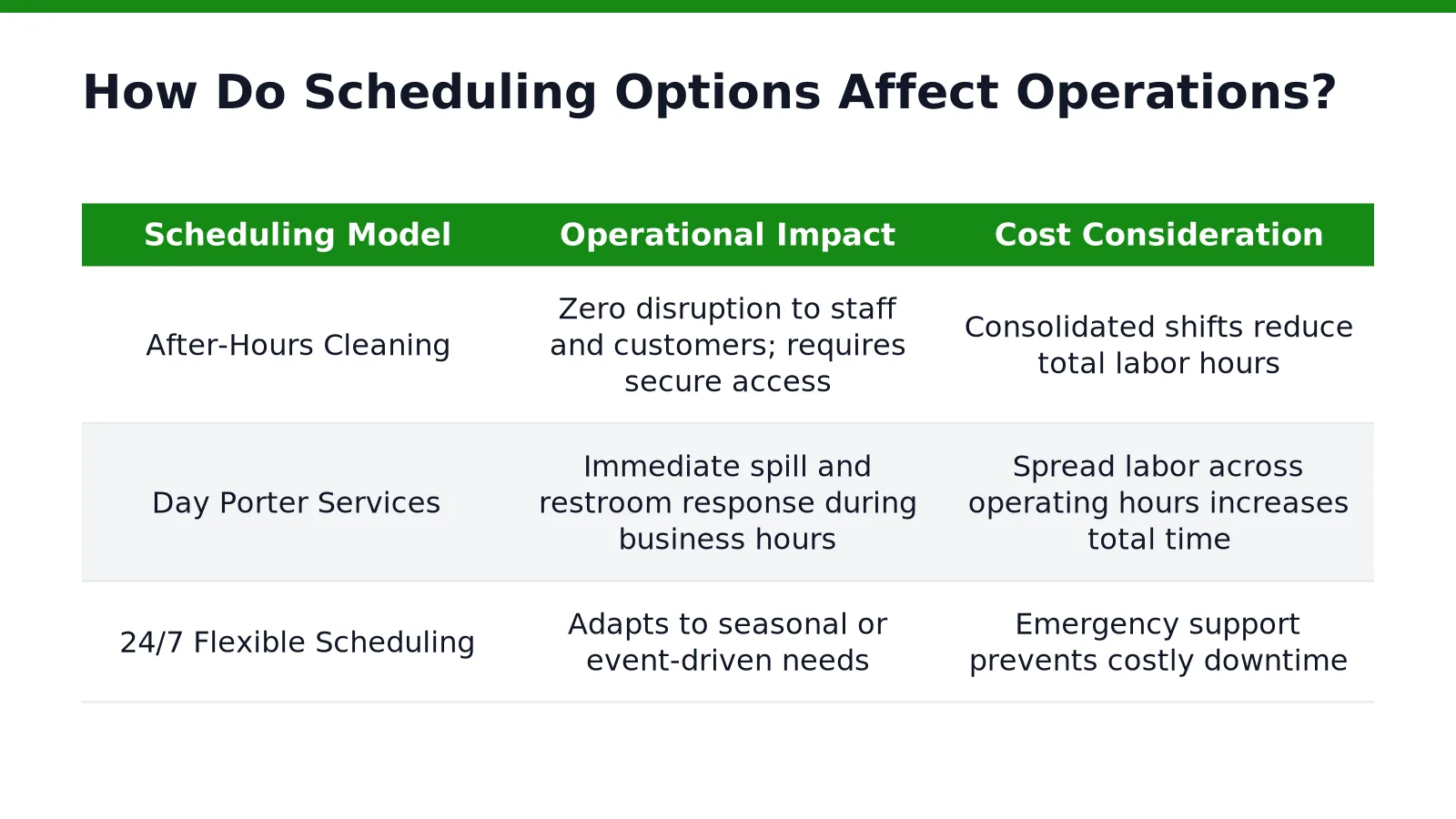
How Do Scheduling Options Affect Operations?
The timing of cleaning services directly affects whether they enhance or hinder daily operations. A rigid schedule forces facility teams to work around the cleaning crew, while adaptable timing integrates janitorial work into off-peak hours without friction.
The Green Bucket provides 24/7 service flexibility to minimize operational disruption. Our team works around the clock to ensure your facility is spotless, whether that means overnight shifts for a medical practice or weekend deep cleans for a school. Flexible, 24/7 scheduling and emergency support are available, so unexpected needs never derail your facility’s readiness.
What is the difference between after-hours cleaning and day porter services?
After-hours cleaning occurs when the building is empty. Crews complete full-scope janitorial tasks without interrupting staff or customers. Day porter services place a cleaner on-site during business hours for continuous upkeep, restroom restocking, and spill response. Each model carries distinct operational and cost considerations. After-hours work avoids congestion but requires secure access protocols. Day porters provide immediate response yet demand coordination with active workflows.
Which scheduling model costs more for a commercial facility?
Cost differences stem from labor allocation, not a fixed premium for one model. After-hours cleaning often consolidates tasks into a single efficient shift, reducing hourly overlap. Day porter services spread labor across operating hours, which increases total billed time for the same square footage. The right choice depends on foot traffic patterns and cleanliness expectations during business hours. A facility with high patient or client volume benefits from continuous daytime coverage despite the higher labor investment.
Our flexible scheduling options adapt to each facility’s rhythm. A financial office needs vacuuming and trash removal after 6 p.m. A medical clinic requires continuous disinfection during patient hours. Matching the schedule to operational reality eliminates the hidden cost of cleaning crews working around your team.

What Are the Main Contract Types Available?
Commercial cleaning agreements fall into two primary structures. Long-term contracts and month-to-month agreements each carry distinct advantages and trade-offs for facility managers.
How do long-term cleaning contracts work?
Long-term agreements typically lock in service scope and pricing for a defined period. These cleaning contracts Orlando businesses sign often span 12 to 36 months. The arrangement provides budget predictability. It also guarantees consistent crew assignments and scheduled quality audits. The trade-off is reduced flexibility if facility needs shift mid-term.
What makes month-to-month cleaning agreements different?
Month-to-month service plans allow businesses to enjoy professional cleaning without a long-term commitment. This cleaning service contracts explained model suits organizations testing a new provider or managing seasonal occupancy changes. Termination requires minimal notice. The structure trades long-term rate stability for operational agility.
Our approach bridges both models. Every program begins with an assessment to align scope, frequency, and products to facility needs. We structure clear service agreements and defined communication paths so expectations remain transparent regardless of contract length. This foundation supports accurate commercial cleaning pricing Orlando decision-makers need when comparing proposals.
Which contract type costs less per service?
Long-term agreements often carry lower per-visit rates because the provider secures recurring revenue. Month-to-month plans may price slightly higher to offset scheduling variability. The right choice depends on whether your priority is cost minimization or operational flexibility. Understanding these cleaning service pricing models helps facility directors build accurate budgets without surprise fees.
How Do You Evaluate Scope of Work Clarity?
Scope of work clarity separates daily maintenance from periodic specialty add-ons. A precise scope prevents service gaps that degrade facility appearance and hygiene over time. Without explicit task definitions, routine waste removal and restroom care dominate the schedule while deeper needs go unmet. Office Pride’s Commercial Cleaning 101 guide notes that janitorial work commonly covers waste removal, restroom care, dusting, vacuuming, and mopping. Commercial cleaning includes those recurring tasks plus periodic services such as carpet cleaning and floor care. Missing that distinction leaves facilities with surface-level maintenance and accumulating hidden grime.
This operational discipline ensures that agreed tasks are performed consistently, not skipped when schedules tighten.
What Should a Cleaning Scope of Work Include?
A complete scope lists daily, weekly, and monthly tasks with clear frequency assignments. It distinguishes routine janitorial duties from specialty services like deep carpet extraction or hard floor refinishing. Without this breakdown, facility managers cannot verify whether they receive the full program they fund.
How Do You Verify Scope Compliance?
Verification requires documented evidence, not trust alone. We provide monthly quality reports that help decision-makers track outcomes against agreed scopes. These reports connect checklist items to photographic proof, creating an audit trail that confirms every line item was addressed. Facility directors use this documentation to validate budget allocation and identify areas needing frequency adjustments.
What Red Flags Should You Watch For?
Unrealistically low cleaning bids often signal hidden fees or supply markups that erode value over time. A price that seems too good to be true typically is. We see facility managers lose budget predictability when vague cleaning contracts orlando providers bury exclusions in fine print. The initial savings vanish once add-on charges for basic supplies, trash liners, or periodic floor care appear on the first invoice.
How Do Low Bids Actually Cost More?
The math is straightforward. A provider quoting below market must recover that margin somewhere. Common tactics include charging separately for consumables, limiting service frequencies after the first month, or skipping deep-cleaning rotations that prevent long-term surface damage. Without a transparent cleaning service pricing models structure, the facility absorbs costs that the contract appeared to cover.
Why Does Staff Turnover Matter to Your Facility?
High crew turnover introduces a hidden cost that most how to budget for janitorial services discussions overlook. When cleaners rotate frequently, institutional knowledge disappears. Missed corners, inconsistent restroom restocking, and security protocol gaps follow. Our staff are trained, uniformed, and background-checked. Every team member undergoes rigorous background checks and receives training in secure cleaning protocols. Detailed check-in and check-out procedures ensure accountability on every visit. This consistency protects your facility from the operational friction that churn creates.
Cleaning service contracts explained simply: the agreement is only as strong as the people executing it. A low rate paired with untrained, unvetted labor exposes your workplace to liability, theft risk, and quality failures that no discount justifies. We structure our partnerships so the scope, the team, and the verification process are documented before service begins.
How Do You Choose the Right Agreement?
Selecting a commercial cleaning agreement requires matching service scope to facility needs through a structured assessment. A methodical walkthrough checklist identifies the precise tasks, frequencies, and special requirements your space demands. Without this alignment, organizations absorb the cost of either over-serviced square footage or under-maintained high-touch zones.
What should a facility walkthrough include before signing a contract?
A thorough walkthrough documents square footage, surface types, occupancy patterns, and hygiene-critical areas. The assessment also flags specialized needs like medical-grade disinfection or high-traffic floor care. This step-by-step evaluation ensures the cleaning service contracts explained in the proposal reflect actual conditions rather than generic assumptions.
Whether a facility requires daily janitorial coverage, after-hours deep cleaning, or weekend-only service, the agreement adapts to operational rhythms. Cleaning contracts Orlando businesses sign should never force a one-size-fits-all cadence onto a unique workplace.
How do contract terms affect service quality over time?
Long-term agreements create stability for both parties. Consistent staffing, familiar site knowledge, and documented quality benchmarks improve with tenure. Commercial cleaning pricing Orlando structures that lock in rates also protect against mid-year increases, a tangible benefit when budgeting annual facility costs.
Our team serves business offices, medical practices, financial institutions, and schools across Central Florida. This breadth means we understand the distinct compliance and cleanliness standards each sector demands. Local knowledge and proximity enable quick response times and consistent site-level quality, two factors that directly influence how to budget for janitorial services without surprise overtime charges or emergency call-out fees.
Cleaning service pricing models vary by frequency, scope, and facility type. Transparent agreements itemize these variables so decision-makers see exactly what drives the monthly invoice. The right contract balances predictable costs with the flexibility to adjust scope as business needs evolve.
Why Choose a Health-First Cleaning Partner?
A health-first cleaning partner prioritizes occupant wellbeing over surface-level appearance. The Green Bucket delivers health‑first, eco‑friendly commercial cleaning with licensed, insured, background‑checked teams. Facilities without this focus accumulate pathogens that standard cleaning misses entirely.
Our approach integrates commercial cleaning pricing orlando structures with documented health outcomes. We deploy hospital-grade solutions for sensitive environments where contamination risks carry operational consequences. Medical practices, schools, and high-traffic offices lose productive days when cleaning protocols fall short. Our teams prevent those losses through rigorous, verifiable methods.
What distinguishes health-first cleaning from standard janitorial work?
Standard janitorial services address visible soil. Health-first programs target microbial threats using non-toxic products and hospital-grade disinfectants where protocols demand them. The Green Bucket has been providing commercial cleaning services for over 14 years with this dual focus. Every service includes photo-verified checklists and monthly quality reports.
How does a cleaning partner’s background affect facility safety?
Unvetted personnel introduce liability that no facility manager can afford. Our company is veteran-owned and family-owned. Every team member completes background checks, carries proper licensing, and maintains full insurance coverage. This operational discipline protects your occupants and your organization from preventable risk.
Cleaning contracts orlando businesses sign should reflect these standards explicitly. We document scope, frequency, and verification methods in clear service agreements. No hidden terms. No ambiguous deliverables. Just measurable cleanliness that supports healthier, more productive workplaces across Central Florida.
FAQ
What are the contract options for commercial cleaning services?
The Green Bucket offers transparent contract options with no hidden fees, including defined service checklists, photo verification, and monthly quality reports.
How does scheduling work for commercial cleaning?
The Green Bucket provides flexible scheduling (daily, weekly, or custom rotations) with 24/7 service flexibility to support or avoid disrupting daily operations.
What is the typical price range for recurring office cleaning?
Recurring office cleaning services are priced based on facility size, scope, and frequency, with rates varying per visit.
Conclusion
Selecting a commercial cleaning partner requires evaluating pricing models, scheduling flexibility, and contract terms as interconnected decisions. A structured facility walkthrough aligns service scope with actual needs, while transparent agreements document deliverables and verification methods. Long-term contracts with stable pricing protect budgets and support consistent quality through familiar, trained teams. Health-first protocols and documented accountability further reduce operational risk. These factors together determine whether a cleaning program supports or undermines facility performance.