
Green Cleaning Certifications Explained
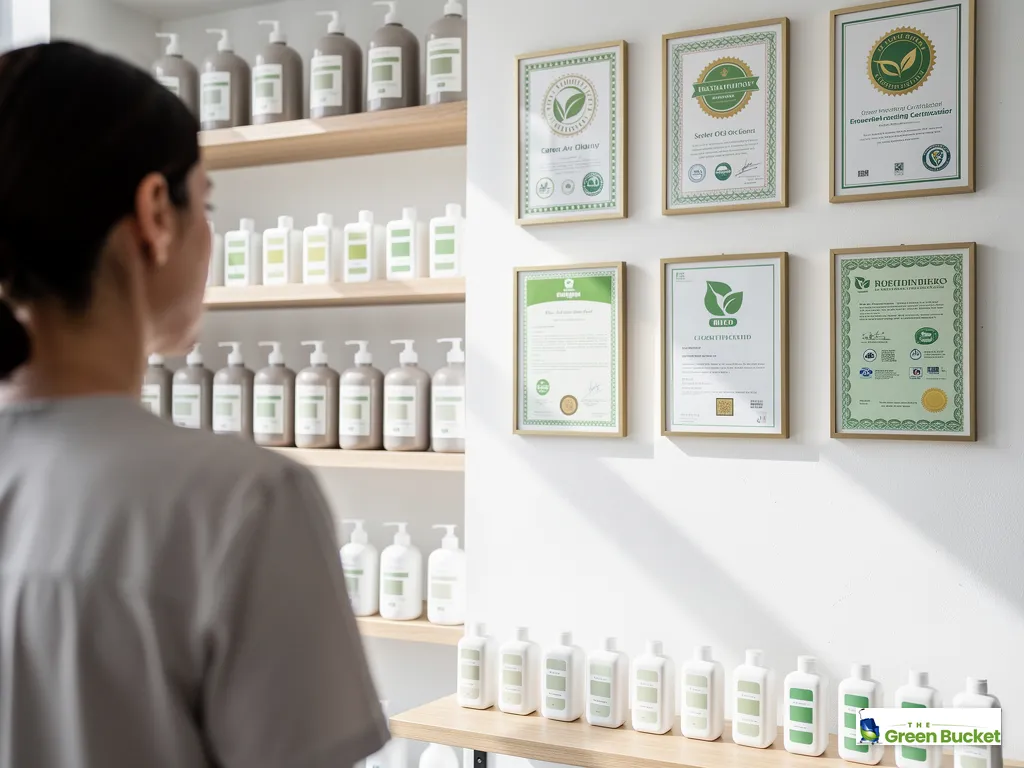
Green business certifications provide third-party validation that a facility meets rigorous environmental standards. LEED, B Corp, and Green Seal are among the most recognized credentials. The Green Bucket has been providing commercial cleaning services for over 14 years.
Key Takeaways
- Green business certifications provide third-party validation that a facility meets rigorous environmental standards.
- Third-party certifications prevent greenwashing by requiring independent verification against transparent criteria.
- The most rigorous certification programs require periodic recertification to ensure standards persist after the initial audit.
- Certified buildings must maintain documented cleaning protocols, waste diversion programs, and indoor environmental quality standards.
What Are Green Certifications for Businesses?
Green business certifications are third-party validations confirming that a company meets established eco-friendly standards. No universal definition of “green” exists, so these credentials provide an objective benchmark. Without independent verification, sustainability claims remain unsubstantiated and expose organizations to accusations of greenwashing. The absence of a recognized green cleaning credential guide leaves facility executives vulnerable to selecting partners whose environmental promises lack measurable proof.
The business case for certification is compelling. Gusto reports that 68% of consumers pay more for sustainable products, a figure that translates directly into competitive advantage for certified operations. Organizations pursuing certified green cleaning programs benefits gain price justification with environmentally conscious clients and strengthen their market position. Failing to secure third-party validation forfeits access to this growing segment of value-driven buyers.
How do third-party certifications prevent greenwashing?
Self-declared environmental claims carry no accountability. A certifying body audits practices, reviews documentation, and confirms compliance before granting credentials. This external scrutiny protects facility managers from investing in services that sound sustainable but deliver no measurable environmental benefit.
What types of green certifications apply to commercial cleaning?
Commercial cleaning operations pursue several certification pathways. Green janitorial accreditation programs evaluate cleaning protocols, product toxicity, equipment efficiency, and staff training. Building-level certifications assess whole-facility performance including indoor air quality and resource consumption. Product-specific credentials verify individual supply chain attributes. The green cleaning certifications explained through these tiers help decision-makers match credentials to operational priorities.
Our team has delivered commercial cleaning services for over 14 years, and we recognize that legitimate certification demands ongoing compliance rather than a one-time achievement. The most rigorous programs require periodic recertification, ensuring standards persist long after the initial audit. Facility executives evaluating service providers should examine which specific credentials a company holds and understand the certification standards that elevate cleaning quality. Selecting a partner with verified credentials protects indoor environmental quality and reinforces organizational sustainability commitments with documented proof.

How Do Facility Certifications Like LEED Work?
Facility certifications provide third-party verification that a building meets specific sustainability and performance benchmarks. Green cleaning certifications explained through this lens reveal a structured process of assessment, documentation, and ongoing compliance. Without certification, facility executives lose the objective proof that distinguishes genuine green operations from superficial marketing claims.
The Green Business Certification Inc. (GBCI) independently verifies sustainability performance against globally recognized standards. GBCI verification enables organizations to receive third-party recognition for demonstrating improvement or reaching self-defined milestones. This independent oversight strengthens market confidence in sustainability investment and innovation.
What Is the Difference Between LEED and Other Facility Certifications?
LEED (Leadership in Energy and Environmental Design) functions as a comprehensive green building certification system with global recognition. Other certifications target narrower performance areas. ENERGY STAR for Commercial Buildings benchmarks energy efficiency and utility reductions specifically. The WELL Building Standard prioritizes occupant health, indoor air quality, and wellness. Each credential serves a distinct purpose within a facility’s overall sustainability strategy.
How Do Facility Certifications Impact Daily Operations?
Our team integrates these requirements into daily janitorial operations through certified green cleaning programs benefits that include improved air quality and reduced chemical exposure. The operational framework demands consistent documentation and periodic performance reviews.
How to get green cleaning certification starts with selecting the appropriate credential for your facility type and operational goals. The process typically involves an initial assessment, implementation of required practices, documentation submission, and third-party verification. Pursuing green janitorial accreditation requires commitment to specific product standards, equipment specifications, and staff training protocols.
A green cleaning credential guide helps facility executives navigate options like LEED, WELL, and ENERGY STAR. Each program evaluates different aspects of building performance. LEED examines whole-building sustainability across multiple categories. WELL focuses exclusively on occupant health metrics. ENERGY STAR tracks utility consumption against national benchmarks. Selecting the right certification depends on organizational priorities and stakeholder expectations. Our experience with understanding green cleaning certifications confirms that facilities pursuing recognized credentials achieve measurable improvements in operational efficiency and occupant satisfaction.
What Is Green Janitorial Accreditation?
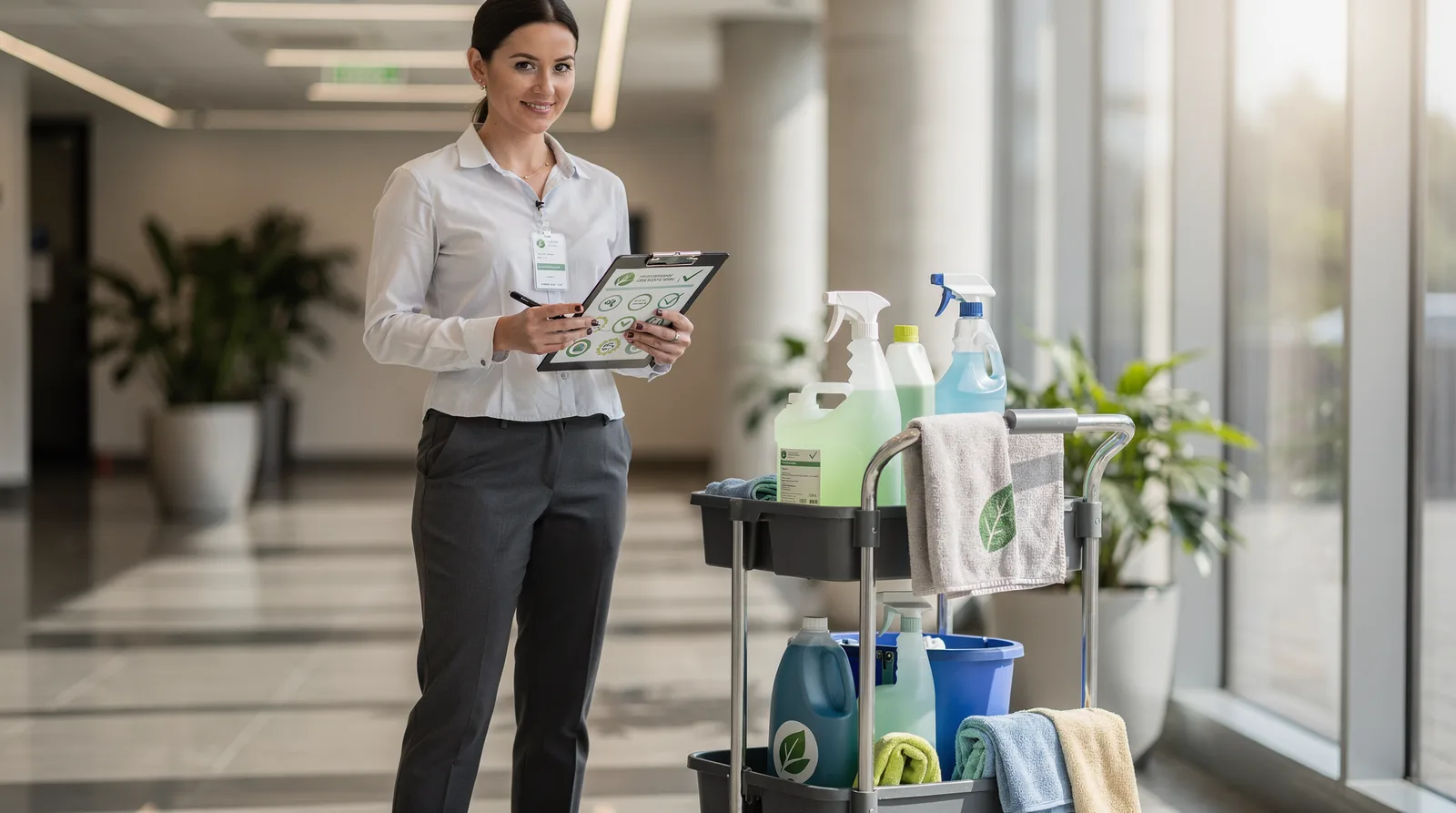
Green janitorial accreditation is a third-party validation confirming that a cleaning service meets defined environmental and health standards. Green cleaning certifications explained simply: an independent body verifies that products, equipment, and procedures reduce chemical exposure and environmental harm. Without this verification, facility executives lose a reliable benchmark for distinguishing genuine sustainability from marketing claims.
The process of how to get green cleaning certification varies by program. Most require an audit of cleaning products, equipment, and operational protocols. Green Seal’s GS-42 standard, for example, sets specific criteria for cleaning services and sustainable inputs. Organizations pursuing green janitorial accreditation must document their use of non-toxic, biodegradable solutions and high-efficiency equipment. Our own operations reflect these requirements. We use non-toxic, biodegradable cleaning products and HEPA-filter vacuums that improve indoor air quality. Our trained, uniformed, and background-checked staff deliver consistent, verifiable results.
What standards apply to green janitorial accreditation?
Green Seal’s GS-42 remains the primary standard for cleaning service providers. It evaluates product toxicity, equipment efficiency, and staff training protocols. No universal definition of “green” exists across all industries, which makes program-specific standards essential for accurate comparison.
How does accreditation benefit facility operations?
Certified green cleaning programs benefits include measurable indoor air quality improvements and reduced chemical residue on surfaces. These outcomes support occupant health and simplify compliance reporting. Our approach to green cleaning credential guide principles emphasizes transparency. We document every service with photo verification and monthly quality reports. This documentation helps decision-makers track outcomes against agreed scopes without guesswork.
Facilities that adopt accredited green cleaning also position themselves for broader sustainability recognition. The operational discipline required for accreditation aligns with frameworks like LEED and other building performance standards. Our eco-friendly cleaning solutions deliver these advantages through structured, verifiable programs.
How to Get Green Cleaning Certification for Your Facility?
Green cleaning certifications explained through a structured process validate a facility’s commitment to health and sustainability. Certification requires a systematic approach across operational, financial, and vendor dimensions. Facilities that skip any step risk audit failure and wasted implementation costs.
What Is the First Step in Pursuing Green Janitorial Accreditation?
The process begins with a baseline operational audit and feasibility study. We assess current cleaning practices, product inventories, and equipment against certification standards. This audit identifies gaps between existing operations and the requirements of recognized bodies like Green Business Certification Inc. (GBCI), which independently verifies sustainability performance against globally recognized standards. Without this diagnostic, facilities invest in changes that miss certification thresholds.
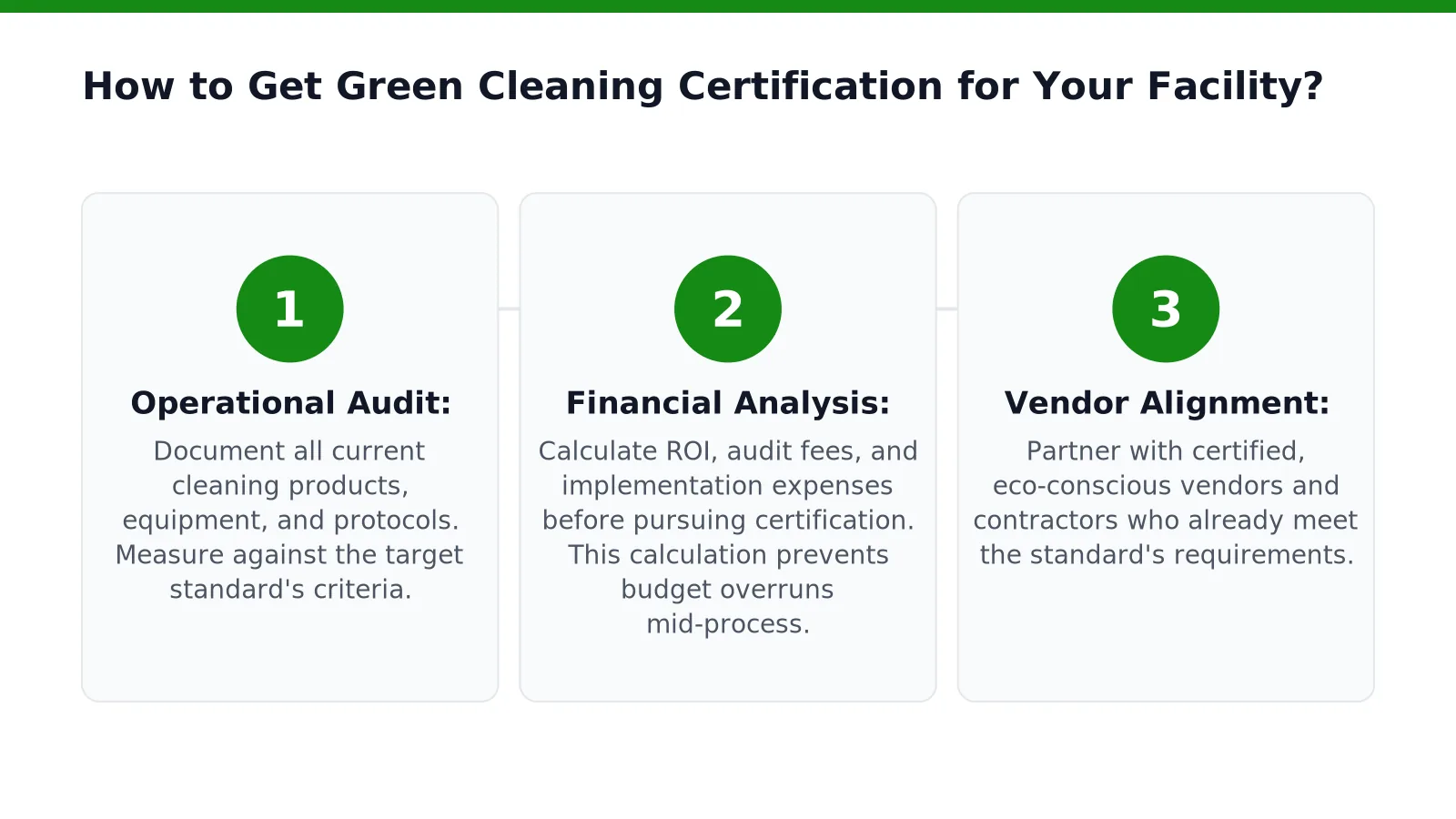
How to get green cleaning certification involves three sequential phases. Each phase builds on the previous one, and rushing the sequence creates compliance gaps that auditors flag immediately.
- Operational Audit: Document all current cleaning products, equipment, and protocols. Measure against the target standard’s criteria.
- Financial Analysis: Calculate ROI, audit fees, and implementation expenses before pursuing certification. This calculation prevents budget overruns mid-process.
- Vendor Alignment: Partner with certified, eco-conscious vendors and contractors who already meet the standard’s requirements.
What Costs Should a Facility Expect During Certification?
Businesses must calculate ROI, audit fees, and implementation expenses before pursuing certification. Direct costs include the certification body’s application and audit fees. Indirect costs cover product transitions, equipment upgrades, and potential staff training. The California Green Business Network notes that conserving energy, water, and resources translates into operational savings, offsetting initial outlay over time. Facilities that skip this financial modeling often stall when unplanned expenses surface during the audit phase.
Why Does Vendor Selection Matter for Green Janitorial Accreditation?
Partnering with certified, eco-conscious vendors and contractors is a critical step in the process. A facility’s certification depends on the products and methods used within it. If a contracted cleaning provider uses non-compliant chemicals, the entire application fails. Certified green cleaning programs benefits include streamlined compliance because vendors already operate within the standard’s framework. Our team supports this alignment directly. The Green Bucket offers 24/7 service flexibility to support certification compliance schedules, ensuring that cleaning operations meet audit requirements without disrupting business hours.
A green cleaning credential guide must emphasize that certification is not a one-time event. GBCI credentials demonstrate proficiency in green building and sustainability, and maintaining them requires ongoing performance verification. Facilities that treat certification as a static achievement lose their standing when standards update or practices drift. The operational audit, financial plan, and vendor partnerships form a continuous cycle rather than a linear checklist.
What Are Certified Green Cleaning Programs Benefits?
Certified green cleaning programs deliver measurable operational and financial advantages. These programs reduce chemical exposure, improve indoor air quality, and strengthen market positioning through verified sustainability credentials.
Green cleaning certifications explained simply: they are third-party validations confirming a cleaning operation meets defined environmental and health standards. No universal definition of “green” exists, so certification provides the objective benchmark facility executives need. The benefits extend across three interconnected areas: competitive differentiation, occupant health outcomes, and operational accountability.
How do certified green cleaning programs improve indoor air quality?
Certified programs mandate low-VOC products and HEPA-filtered equipment. These requirements directly reduce airborne contaminants that trigger respiratory issues and absenteeism. Our certified green cleaning programs benefits include documented improvements in indoor environmental quality through protocols aligned with LEED and WELL building standards.
What financial advantages do green janitorial credentials provide?
Green janitorial accreditation creates pricing power and customer preference. A Gusto analysis of green business certifications reports that 68% of consumers pay more for sustainable products. This willingness extends to commercial tenants and building occupants who prioritize health-conscious environments. The competitive advantage compounds when facilities market their certification status to prospective lessees and clients.
How to get green cleaning certification involves implementing documented standard operating procedures with compliance logs and tracking systems. Certification bodies require evidence of consistent practice, not just product purchasing. Our green cleaning credential guide approach emphasizes that documentation and tracking form the backbone of maintaining certification status. Without verifiable compliance records, credentials lapse and the associated market benefits disappear.
The Green Bucket’s “Green Cleaning for Health” methodology integrates eco-friendly products with hospital-grade solutions where required. This dual-capability approach means facilities achieve certification-level environmental performance without compromising infection control in high-risk areas. The operational framework includes detailed checklists, photo verification, and monthly quality reports that satisfy auditor requirements while giving facility managers transparent oversight of cleaning outcomes.
How Do Operational Certifications Like B Corp Work?
Operational certifications validate a company’s entire management system, not just a single product. B Corp Certification evaluates governance, social performance, and environmental accountability across the whole organization. Without this verification, businesses lose the credibility that 68% of consumers now demand when choosing sustainable partners, according to Gusto’s 2026 analysis of green certifications.
The process demands rigorous documentation and third-party auditing. Companies submit evidence of ethical supply chains, employee benefits, and environmental impact. A score across multiple categories determines eligibility. This holistic model contrasts sharply with single-attribute labels.
What Does B Corp Certification Actually Measure?
B Corp standards examine five impact areas: governance, workers, community, environment, and customers. The assessment weighs how decisions affect all stakeholders, not just shareholders. Companies must amend legal governing documents to embed stakeholder commitments. Recertification occurs every three years, ensuring continuous improvement rather than a one-time achievement.
How Does ISO 14001 Differ from B Corp?
ISO 14001 provides a framework for implementing a certified Environmental Management System (EMS). The standard focuses exclusively on environmental performance through a plan-do-check-act cycle. Organizations identify impacts, set objectives, and monitor progress. B Corp takes a broader view, folding social equity and governance into the evaluation. Both certifications require external verification, but their scopes serve different strategic goals.
Green janitorial accreditation programs often align with these frameworks. The Green Business Certification Inc. (GBCI) offers credentials that demonstrate proficiency in green building and sustainability. These credentials help professionals showcase their knowledge and credibility in the green building sector. Facility executives pursuing certified green cleaning programs benefits gain documented proof of operational rigor.
Our own structure reflects these governance principles. The Green Bucket is a veteran-owned company, a designation that signals commitment to disciplined operations and community values. We apply the same systematic thinking to our cleaning protocols. Understanding how to get green cleaning certification starts with selecting the framework that matches organizational priorities. A green cleaning credential guide helps decision-makers weigh B Corp’s comprehensive scope against ISO 14001’s environmental specificity. The right choice depends on whether leadership seeks broad stakeholder accountability or targeted environmental management.
What Costs Are Involved in Green Certification?
Green certification costs vary widely by certification type, facility size, and scope of operations. No universal fee schedule exists across the green cleaning certification landscape. Facility executives must evaluate each program’s cost structure against operational realities.
Green cleaning certifications explained through their cost components reveal three primary expense categories. Audit fees cover third-party verification of compliance. Product upgrades require replacing conventional chemicals with certified alternatives. Documentation systems demand time and software investment for ongoing compliance tracking.
What Are the Main Cost Categories for Certification?
- Audit and verification fees: Third-party assessors charge for initial reviews and site inspections.
- Product and equipment upgrades: Certified green cleaning programs require specific non-toxic products and HEPA-filtered equipment.
- Documentation and reporting systems: Compliance tracking demands record-keeping infrastructure.
- Staff training: Personnel must learn new protocols and product handling procedures.
Implementation expenses include audit fees, product upgrades, and documentation systems. These costs scale with facility complexity. A multi-site medical practice carries different certification economics than a single professional office.
How Do Recertification Costs Work?
Recertification cycles require ongoing monitoring and continuous improvement investments. Certification is not a one-time purchase. Annual or biennial renewal fees apply. Facilities must demonstrate sustained compliance through updated documentation and periodic audits.
The Green Bucket provides transparent pricing based on facility size, frequency, and scope. Our assessment process identifies which certification pathway aligns with operational budgets. We document every cost component before implementation begins. This approach eliminates surprise expenses during the certification journey.
How to Choose the Right Certification for Your Business?
Selecting a green cleaning certification requires narrowing the field to one or two credentials that match operational values and market expectations. Pursuing too many certifications dilutes focus and stretches resources without proportional return. The most effective approach prioritizes programs with transparent evaluation processes, ensuring the credential carries verifiable weight rather than empty marketing language.
How do transparent evaluation processes protect certification integrity?
Third-party verification separates legitimate green janitorial accreditation from superficial claims. Programs that publish clear standards, audit procedures, and renewal requirements give facility executives confidence that certified providers meet measurable benchmarks. Without this transparency, a certification offers no assurance of actual environmental performance.
What factors determine the right certification for a specific facility?
Alignment with business values and target market drives the selection. A medical office prioritizing infection control alongside sustainability needs different credentials than a corporate headquarters focused on indoor air quality. The certified green cleaning programs benefits include operational credibility and differentiation, but only when the chosen certification speaks directly to the facility’s risk profile and stakeholder concerns.
Our team builds customized plans after on-site assessments to align cleaning protocols with the standards required by each credential. For organizations across Orange, Seminole, and Osceola Counties, this green cleaning credential guide approach ensures the certification supports real facility outcomes. We evaluate scope, frequency, and product requirements against program criteria before recommending a path forward.
FAQ
What green certifications apply to commercial cleaning?
Green janitorial accreditation programs evaluate cleaning protocols, product toxicity, equipment efficiency, and staff training. How do third-party certifications prevent greenwashing?
Do green certifications require ongoing compliance?
Legitimate certification demands ongoing compliance rather than a one-time achievement.
Conclusion
Selecting a green certification requires matching a credential’s scope to a facility’s operational priorities and market expectations. Facility executives should evaluate each program’s audit transparency, cost structure, and recertification requirements before committing resources. The right choice delivers documented environmental performance and stakeholder confidence, not just a marketing label.